
The 2030 Agenda for Sustainable Development and the UNFPA Strategic Plan are grounded in the core commitment to leaving no one behind (LNOB) and reaching the furthest behind. To strengthen UNFPA's implementation of this principle, this landmark evaluation assesses the integration of LNOB across all of UNFPA's programming and operations—development and humanitarian—at the global, regional, and country levels, covering the 2018-2024 period.
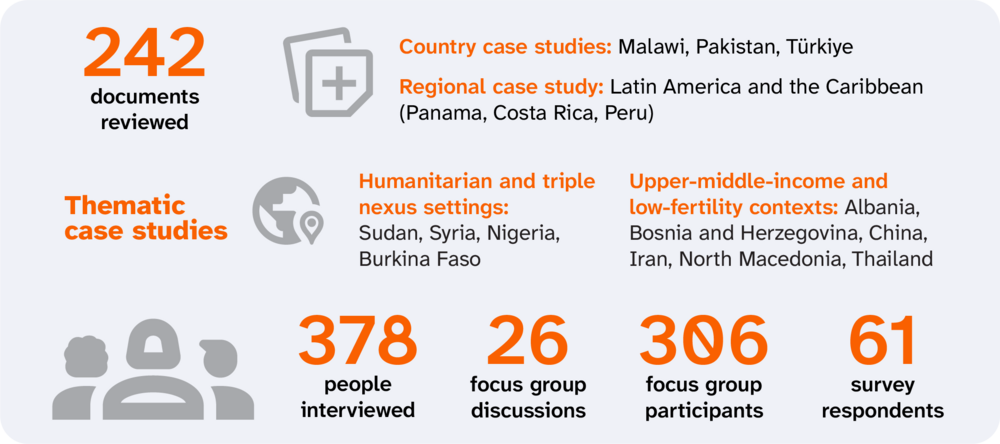
The evaluation was guided by a participatory governance structure that directly embodied the LNOB principles. A Steering Committee co-managed the process alongside UNFPA IEO, composed of rights holders with lived experiences of exclusion and discrimination, including indigenous peoples, refugees, and persons with disabilities. This Committee provided input on the evaluation design and methodology, and validated emerging findings, effectively acting as a mechanism to rebalance power dynamics in the evaluation process.
Quick facts
The evaluation highlights that while the LNOB principle is widely understood and well integrated into UNFPA’s strategies and across its programming work, its full potential is constrained by uneven implementation, limited institutional ownership, and inconsistent resource allocation. Nevertheless, the value of LNOB remains clear and UNFPA’s key strengths in this work include its strong convening role and its leadership in disaggregated population data. The evaluation finds that UNFPA programming is largely LNOB-responsive. While these interventions are effective, they do not always bring about transformative change that address root causes of exclusion. Overall, the LNOB Operational Plan represents a significant and positive step for UNFPA, reinforcing its commitment to inclusion and empowerment.
Going forward, the evaluation recommends that UNFPA must intensify its commitment to LNOB by strengthening institutional accountability by embedding LNOB priorities into all corporate systems, work plans, and performance management. Furthermore, UNFPA should actively enhance workforce diversity and uphold LNOB values building on the progress already made by the UNFPA 2030 People Strategy. To support these efforts, the evaluation also recommends clearer conceptual linkages, positioning LNOB not only as a principle, but as a central pathway to achieving UNFPA’s transformative results and the Sustainable Development Goals. In addition, stronger communication of the LNOB vision, strengthening partnerships to support diverse civil society organizations, and the development of an internal programmatic learning series will be essential to cultivate an organizational culture in which LNOB is fully internalized.
