
Middle East Crisis
As the humanitarian crisis deepens across the Middle East, tens of thousands of people have been killed, injured and displaced, with civilians the hardest hit. Amid widespread destruction, healthcare facilities and workers have been repeatedly targeted, further endangering lives and limiting access to crucial services when they are most needed.
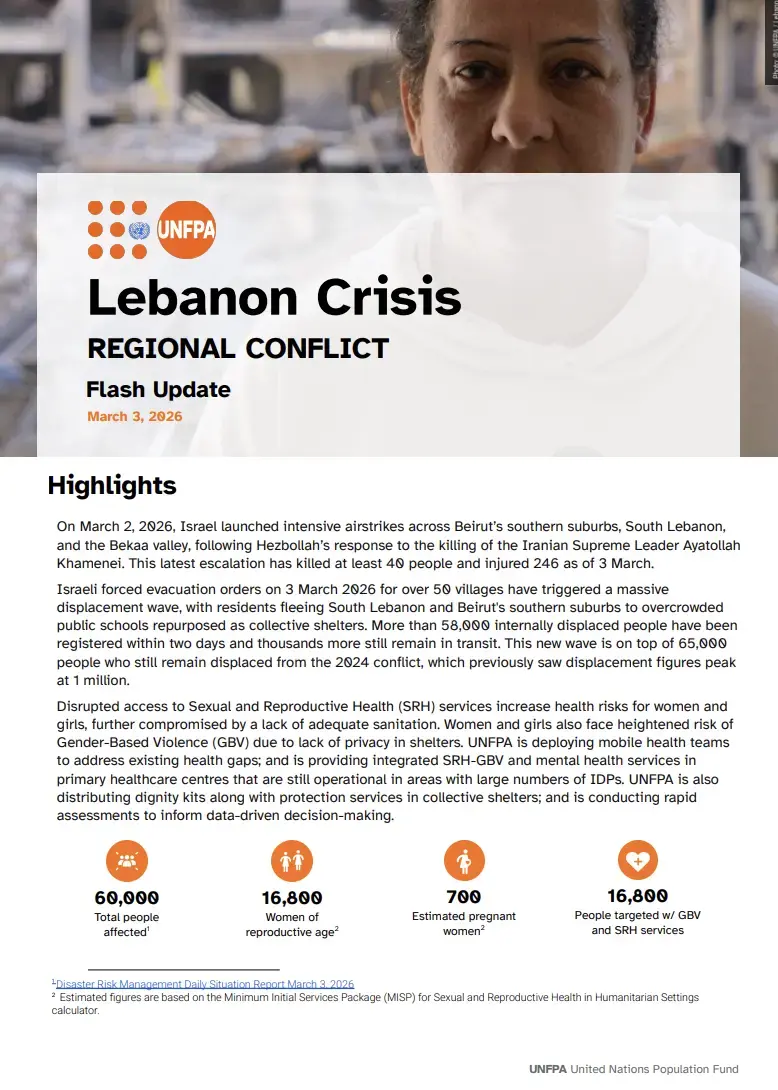
Mass and sudden displacement is ongoing across the region: Multiple strikes on Iran have uprooted millions of people and more than 1.2 million have been forced from their homes by escalating violence in Lebanon – adding to the tens of thousands already displaced since 2024. Many families are sheltering in overcrowded, makeshift shelters with scarce health, hygiene or protection services, while others are camping on the streets.
Tens of thousands have fled across borders from Iran into Afghanistan and from Lebanon into Syria, a country still recovering from 15 years of conflict. In Jordan, which hosts over 400,000 refugees, asylum seekers and stateless people, the war is intensifying existing socioeconomic pressure. Gulf countries have also suffered strikes that have damaged infrastructure and raised concerns about immediate and longer-term impacts on civilians.
In every country, women and girls face devastating impacts on their health, safety and futures as hundreds of thousands lose access to gender-based violence response and healthcare. Pregnant women and new mothers are particularly vulnerable, as disrupted maritime and air routes have delayed crucial medical and humanitarian deliveries to crisis-affected areas.
Read more text
UNFPA is scaling up its operational capacity to meet the urgent needs of women and girls, tailoring its approach to each context. In overcrowded shelters and informal settlements, the risk of gender-based violence rises dramatically, including sexual exploitation, coercion and child marriage. UNFPA is establishing safe spaces, deploying female case workers, and ensuring survivors have access to confidential support and referral pathways. As the only agency dedicated to ensuring the continuity of reproductive health services, UNFPA is deploying mobile medical teams and midwives to reach women cut off from care. These services are essential to preventing maternal and newborn deaths in crisis settings.
With the risk of large-scale cross-border displacement into Iraq, UNFPA is closely coordinating with the government and partners to prepare a timely, coordinated and gender-responsive humanitarian response. In Jordan, UNFPA is working to mitigate the risk of exacerbating vulnerabilities among large populations of Syrian refugees and host communities, at a time when humanitarian funding has been severely reduced. In Lebanon, UNFPA is providing sexual and reproductive health services and gender-based violence response in collective shelters as well as through mobile health teams and referrals to primary health facilities. And in Syria, UNFPA is working with partners to deliver health and protection services for displaced and host communities.
Updated 1 April 2026