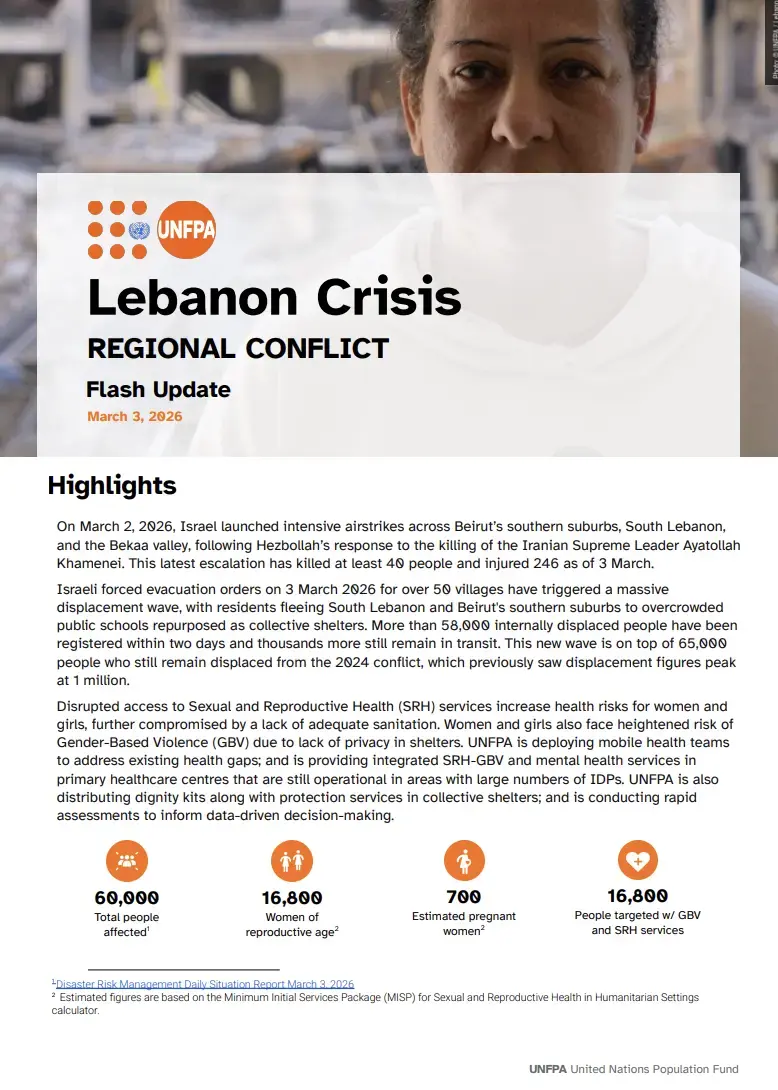

On March 2, 2026, Israel launched intensive airstrikes across Beirut’s southern suburbs, South Lebanon, and the Bekaa valley, following Hezbollah’s response to the killing of the Iranian Supreme Leader Ayatollah Khamenei. This latest escalation has killed at least 40 people and injured 246 as of 3 March.
Israeli forced evacuation orders on 3 March 2026 for over 50 villages have triggered a massive displacement wave, with residents fleeing South Lebanon and Beirut's southern suburbs to overcrowded public schools repurposed as collective shelters. More than 58,000 internally displaced people have been registered within two days and thousands more still remain in transit. This new wave is on top of 65,000 people who still remain displaced from the 2024 conflict, which previously saw displacement figures peak at 1 million.
Disrupted access to Sexual and Reproductive Health (SRH) services increase health risks for women and girls, further compromised by a lack of adequate sanitation. Women and girls also face heightened risk of Gender-Based Violence (GBV) due to lack of privacy in shelters. UNFPA is deploying mobile health teams to address existing health gaps; and is providing integrated SRH-GBV and mental health services in primary healthcare centres that are still operational in areas with large numbers of IDPs. UNFPA is also distributing dignity kits along with protection services in collective shelters; and is conducting rapid assessments to inform data-driven decision-making.


