

DAVOS, Switzerland – Against the backdrop of the 2026 World Economic Forum Annual Meeting, UNFPA, the United Nations Population Fund – which is the UN’s sexual and reproductive health agency – joined global business leaders to issue a powerful call to action: Investing in women’s health is not just a moral imperative, it is a cornerstone of economic resilience and corporate productivity.
At a flagship high-level side event entitled ‘Invest in health, invest in people: Corporate action for workplace wellbeing’, co-hosted with Ferring Pharmaceuticals and the Ministry of Foreign Affairs of Finland, UNFPA launched the inaugural Annual Report of the Coalition for Reproductive Justice in Business. The report documents a year of transformative progress, showing how forward-thinking companies are redefining corporate social responsibility by embedding sexual and reproductive health and rights into their core business models.
Leveraging the ‘future of work’ dividend
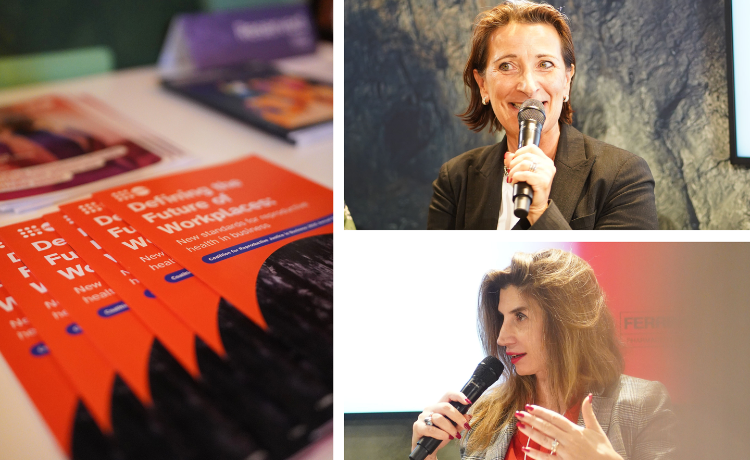
The event highlighted that despite making up 40 per cent of the global workforce, their specific health needs – ranging from menstruation and maternity to menopause – are often overlooked in corporate policy. The Coalition’s work demonstrates that addressing these needs yields a ‘future of work’ dividend: Research indicates that workplace programmes that account for women’s reproductive health can lead to a 22 per cent increase in productivity, a 62 per cent reduction in absenteeism, and a 23 per cent reduction in talent attrition.
UNFPA Executive Director Diene Keita said, “We’re advocating in the corporate halls of power for women’s access to sexual and reproductive health and rights because it is both a human right and foundational to workforce stability and economic growth. It’s about investing in the people who sustain organizations and economies worldwide.”
“From the factory floor to the C-suite, working women may be unsung – but they are not unseen. Certainly not by UNFPA.” - Diene Keita, UNFPA Executive Director
Real impact on the workforce – and the workplace
Since its launch in 2023, the Coalition has grown into a flagship initiative, with 27 companies now engaging nearly 800,000 employees directly.
Corporations such as Bayer, Essity and Nestlé, are mitigating the estimated US $150 billion in annual global productivity losses associated with menopause symptoms by implementing flexible work arrangements, cooling infrastructure, and manager training to ensure high-performing women remain in the workforce during the peak of their careers.
By leveraging UNFPA’s Return on Investment Tool, partners such as Shahi Exports demonstrated that menstrual health is a high-return investment in worker well-being. They saw up to 300 per cent return (up to $3 return for every $1 spent) by providing high-quality menstrual products and health education, which significantly reduced absenteeism and improved the daily comfort and performance of their female workforce.
Corporate leadership in action
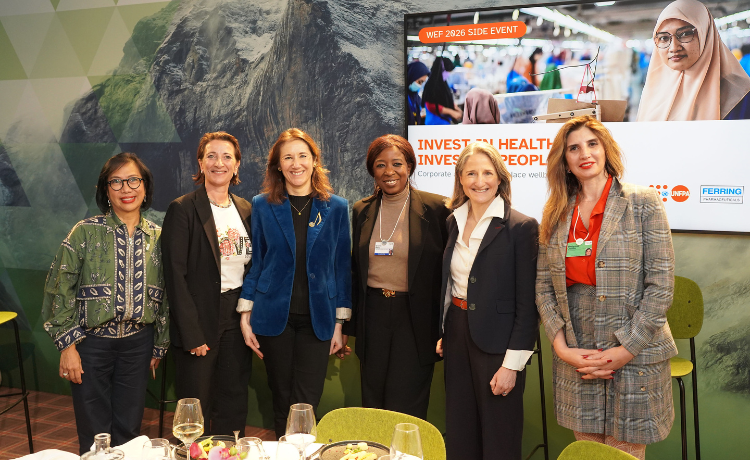
A dialogue session at Davos was moderated by Tamzin Booth, Editorial Director for Economist Impact, and featured insights from private sector leaders from Ferring Pharmaceuticals, Nestlé and Grab Indonesia. The leaders discussed how public policy and private investment must align to ensure workforce resilience.
“Investing in women’s health is not a cost, it is a strategic business decision”, said Aude Rey, Global Business Head for Adult Nutrition at Nestlé. “When women’s health is embedded in business strategy, it creates exponential shared value – for companies, communities and society at large.”
Grab provides mobility, delivery and financial services across eight South-East Asian countries. In Indonesia, they are now setting a benchmark for sexual violence prevention and incident reporting in collaboration with UNFPA. “Our zero-tolerance policy on sexual harassment, strengthened by the use of data analytics and face-to-face training across five Indonesian cities, has contributed to a 43 per cent reduction in reported sexual harassment cases,” said Neneng Goenadi, Chief Executive Officer of Grab Indonesia.
Christelle Beneteau, Chief People Officer at Ferring Pharmaceuticals, added, “At Ferring, we believe in helping people build families. For example, we offer 26 weeks of fully paid parental leave for birthing and non-birthing parents globally, and this helps us level the playing field. Studies have shown that this can reduce risks of postnatal depression, and has a huge impact on the number of women returning to work after childbirth.”
Setting new standards
Closing the women’s health gap is the boldest business investment. By 2040, addressing women’s health could add up to $1 trillion to the global economy, a return that can drive economic productivity, reduce healthcare costs, and ensure stronger, healthier generations to come.
As the Coalition enters its next phase, it is encouraging the wider adoption of UNFPA’s sexual and reproductive health and rights metrics to ensure corporate policies are both measurable and transparent. With the potential to influence global supply chains that employ hundreds of millions of women, the Coalition is setting a new standard for the private sector – one where no one, from the C-suite to the factory floor, is left behind.


