Ending GBV and harmful practices

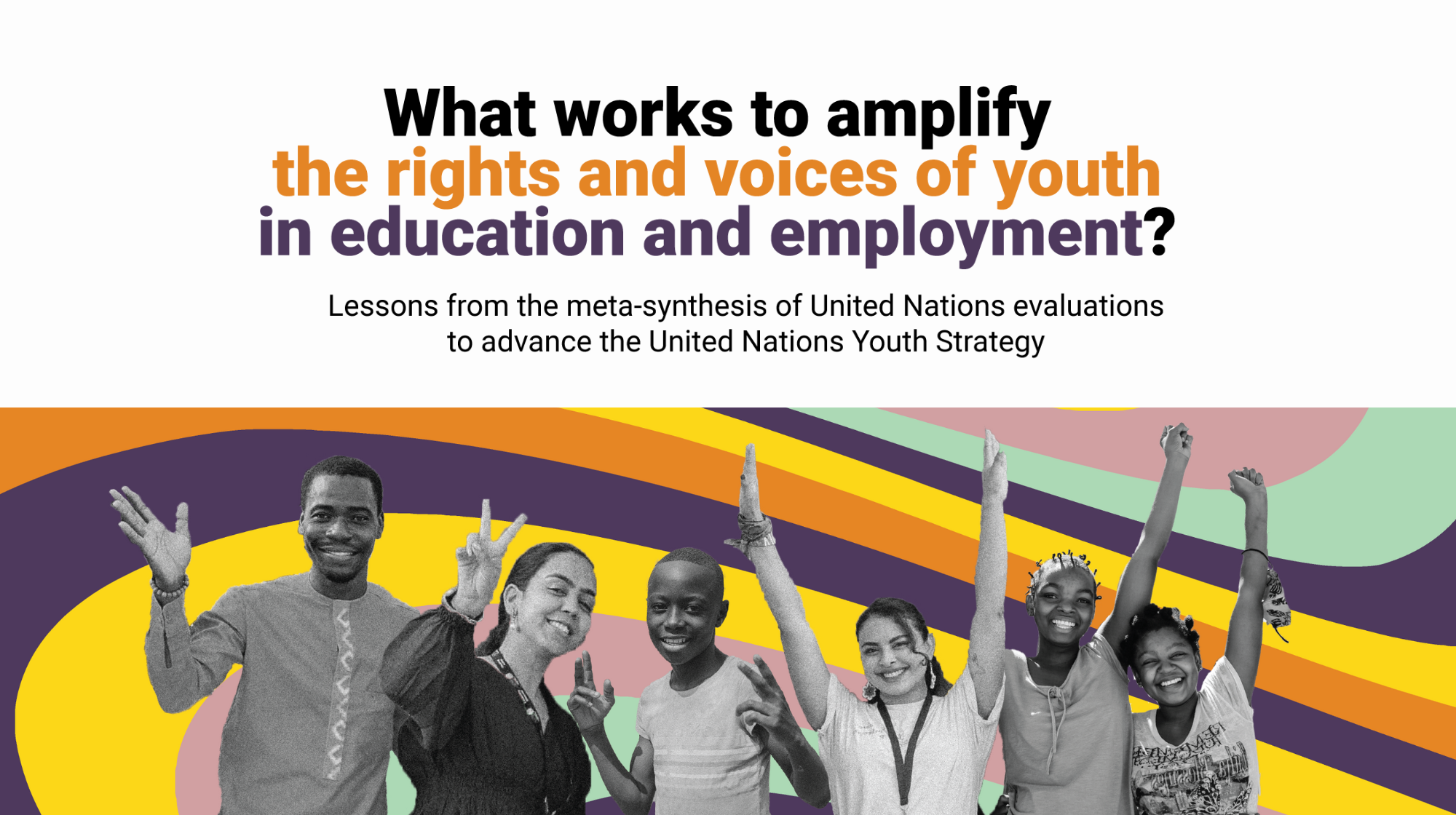
What works to amplify the rights and voices of youth in education and employment?

What works to amplify the rights and voices of youth in education and employment?

Document date: 2025

Evaluation type: Global

Region: n/a

Joint evaluation: n/a

System-wide evaluation: Yes

Download resources

Drawing on about 300 United Nations evaluations and employing a responsible AI-enabled methodology, this evidence synthesis report provides validated lessons on what works and what doesn't in advancing youth education and employment programmes. These lessons directly contribute to the implementation of the United Nations Youth Strategy 2030.

The lessons emphasize the need for targeted interventions and tailored approaches for specific disadvantaged youth groups, the importance of cross-sector collaboration and holistic approaches to enhance youth employability and personal development, the necessity of tailoring educational programmes to local and cultural realities, and the value of a balanced approach combining direct youth support and upstream strategies for long-term success. By applying these lessons to programme design, budget allocation and advocacy, programmers and decision-makers can ensure young people are better prepared for the future of work and learning.

The report is a result of an inter-agency knowledge collaboration, co-led by the UNFPA Independent Evaluation Office and UNICEF Evaluation Office, along with the EvalYouth Global Network, Generation Unlimited, Global Partnership for Education Youth Leaders, ILO, IOM, OHCHR, UNDP, UNESCO, and the United Nations Youth Office. The report was officially launched at a Youth ECOSOC Forum side event on 15 April 2025. 

This is the third report, part of a series of four meta-synthesis exercises on lessons learned in the implementation of the United Nations Youth Strategy. The first synthesis focused on ‘What works to amplify the rights and voices of youth?’ by exploring youth participation and youth and human rights. The second synthesis focused on ‘What works to amplify the rights and voices of youth in peace and resilience building?’. Together this evidence package aims at strengthening the United Nations effectiveness on youth programming globally.

Evaluation documents

Meta-synthesis Report
Lessons Summary
Meta-synthesis Presentation

Additional resources

UNFPA Timor-Leste 4th Country Programme Evaluation (2021-2025)

Document date: 2025

Evaluation type: Country

Region: Asia & the Pacific

Country: Timor-Leste

Joint evaluation: n/a

System-wide evaluation: n/a

Download resources

The evaluation assesses the relevance, coherence, effectiveness, efficiency, and sustainability of UNFPA work in Timor-Leste, including in humanitarian settings. 

Evaluation documents

Evaluation Report
Evaluation Quality Assessment

Additional resources

UNFPA Serbia 2nd Country Programme Evaluation (2021-2025)

Document date: 2025

Evaluation type: Country

Region: Eastern Europe & Central Asia

Country: Serbia

Joint evaluation: n/a

System-wide evaluation: n/a

Download resources

The evaluation provides an independent assessment of the UNFPA Serbia country programme covering the years 2021-2024 and broadens the evidence base for designing the next country programme.

Evaluation documents

Evaluation Report
Evaluation Quality Assessment

UNFPA Uganda 9th Country Programme Evaluation (2021 - 2025)

Document date: 2025

Evaluation type: Country

Region: East & Southern Africa

Country: Uganda

Joint evaluation: n/a

System-wide evaluation: n/a

Download resources

This evaluation aims to provide an independent assessment of the UNFPA country programme in Uganda and to broaden the evidence base to inform the design of the next programme cycle. 

Evaluation documents

Evaluation Report
Evaluation Quality Assessment

Evaluación del séptimo programa del UNFPA para México (2020-2024)

Document date: 2024

Evaluation type: Country

Region: Latin America & the Caribbean

Country: Mexico

Joint evaluation: n/a

System-wide evaluation: n/a

Download resources

El propósito de la Evaluación del Programa de País es proporcionar una evaluación independiente del séptimo programa de país 2020-2024 del Fondo de Población de las Naciones Unidas en México. Esta evaluación tiene como objetivo informar el diseño del próximo programa del país y rendir cuentas a las partes interesadas. 

Evaluation documents

Evaluation Report
Evaluation Quality Assessment

Additional resources

Review of UNAIDS Joint Programme evaluations and assessments (2020-2024)

Review of UNAIDS Joint Programme evaluations and assessments (2020-2024)

Document date: 2025

Evaluation type: Global

Region: n/a

Joint evaluation: Yes

System-wide evaluation: n/a

Download resources

The UNAIDS Joint Programme is a multi-stakeholder and multisectoral initiative that leads the United Nations system’s response to the global AIDS epidemic. The purpose of this review was to consolidate and analyze findings from previous Joint Programme evaluations, assessments, and reviews conducted between 2020 and 2024, as well as their management responses, to inform ongoing processes and an upcoming evaluation of the Joint Programme. 

The UNAIDS Evaluation Office led the review, with support from a Management Group that included the UNFPA Independent Evaluation Office, alongside the UNAIDS Secretariat, UNESCO, UNICEF and WHO. 

This review analyzed the Joint Programme’s work across several dimensions, focusing on its successes, key internal and external challenges, and opportunities in relation to the UNAIDS Joint Programme’s programmatic objectives. It also analyzed existing evidence on the extent to which key Joint Programme structures were fit-for-purpose, and the added value of the Joint Programme in sustaining the HIV response.
 

Evaluation documents

Review Report

Evaluación Formativa del Programa Regional para América Latina y el Caribe (2022-2025)

Document date: 2024

Evaluation type: Regional

Region: Latin America & the Caribbean

Joint evaluation: n/a

System-wide evaluation: n/a

Download resources

El objetivo principal de la evaluación formativa del Programa Regional del UNFPA para América Latina y el Caribe 2022-2025 fue proporcionar evidencia para mejorar el aprendizaje organizacional y acelerar el progreso hacia los Tres Resultados Transformadores: Cero necesidades insatisfechas de planificación familiar, cero muertes maternas prevenibles, y cero violencias de género y prácticas nocivas. 

Evaluation documents

Evaluation Report

UNFPA South Africa 5th Country Programme Evaluation (2020-2025)

Document date: 2024

Evaluation type: Country

Region: East & Southern Africa

Country: South Africa

Joint evaluation: n/a

System-wide evaluation: n/a

Download resources

This evaluation aims to provide an independent assessment of the UNFPA country programme in South Africa and to broaden the evidence base to inform the design of the next programme cycle. 

Evaluation documents

Evaluation Report
Evaluation Quality Assessment
Management Response

Video

A refugee entrepreneur rebuilds her life after fleeing war in Sudan

calendar_today26 February 2025

A refugee entrepreneur rebuilds her life after fleeing war in Sudan

A refugee entrepreneur rebuilds her life after fleeing war in Sudan

Meet Wasila, a refugee, entrepreneur and baker.

The violent civil war in Sudan forced her to flee her home.

With support from UNFPA—the United Nations sexual and reproductive health agency, she now runs her own baking business in the Central African Republic.

Stand with refugees and let her story of resilience inspire you.

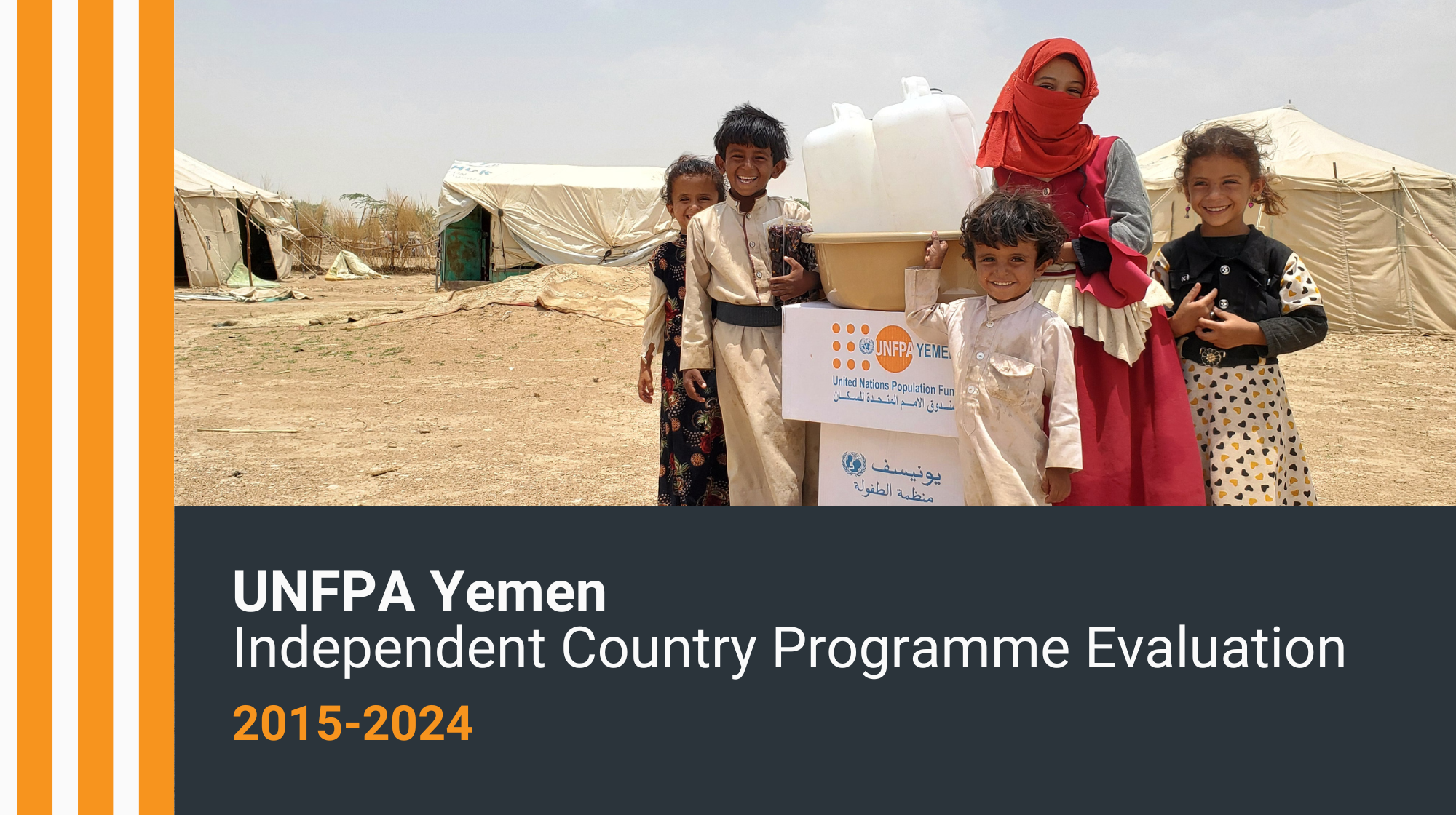
Independent Country Programme Evaluation of UNFPA Yemen (2015-2024)

UNFPA Yemen Independent Country Programme Evaluation 2015-2024

Document date: 2024

Evaluation type: Country

Region: Arab States

Country: Yemen

Joint evaluation: n/a

System-wide evaluation: n/a

Download resources

Yemen is in a dire humanitarian crisis after nine years of war, with over half of its population needing aid. Displaced women and girls, especially those with disabilities, struggle to access reproductive health care and are at high risk of gender-based violence. UNFPA has been coordinating and providing reproductive health and protection services since the start of the crisis, and leading the rapid response mechanism for immediate assistance to displaced people since 2018. This independent evaluation undertaken by the UNFPA Independent Evaluation Office assesses UNFPA's response to the crisis in Yemen from 2015 to the present.

The evaluation finds that UNFPA effectively adjusted its programme in Yemen to meet the changing needs of the population, while remaining sensitive to the socio-political context. Although starting with very limited services, UNFPA's work in reproductive health, gender-based violence, and youth programmes led to positive outcomes. UNFPA also successfully adapted its systems and leveraged its partnerships to meet the demands of the humanitarian crisis. The evaluation also highlights the need for UNFPA to strengthen its engagement with vulnerable groups, particularly persons with disabilities. The evaluation recommends better integration of short-term humanitarian efforts with long-term approaches for resilience building and development.
 

Evaluation documents

Evaluation Report
Executive Summary
Evaluation Quality Assessment
Management Response

Additional resources

We use cookies and other identifiers to help improve your online experience. By using our website you agree to this, see our cookie policy

X