
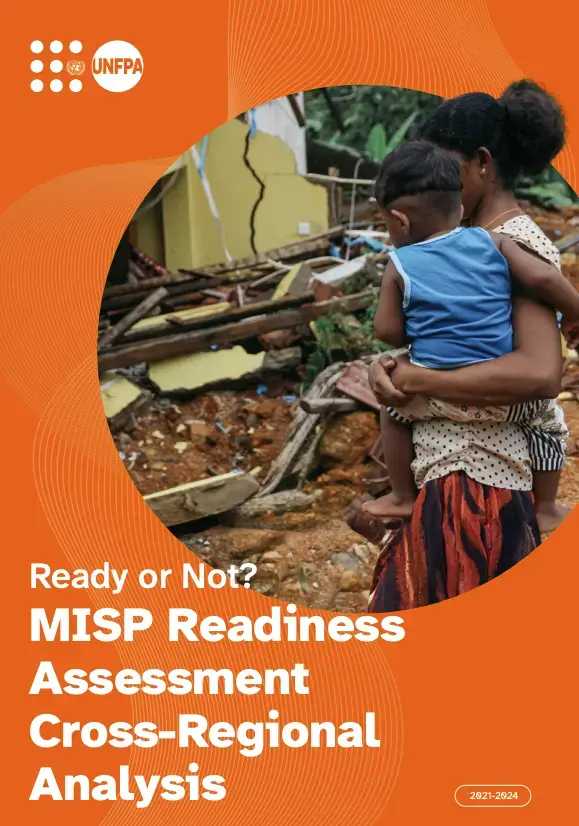

Ready or Not? MISP Readiness Assessment Cross-Regional Analysis (2021–2024) provides a comprehensive overview of global readiness to implement the Minimum Initial Service Package (MISP) for Sexual and Reproductive Health (SRH) in Humanitarian Settings. The MISP defines a set of priority, life-saving interventions to be delivered at the onset of crises and sustained throughout response and recovery.
The report synthesises findings from 77 country-level MISP Readiness Assessments conducted between 2021 and 2024, with in-depth analysis of 64 countries and six regional reports. These assessments evaluate preparedness across five core domains: policy environments, coordination mechanisms, data systems, resource availability and service delivery. Together, they provide the most extensive cross-regional snapshot to date of countries’ capacity to deliver essential SRH services during emergencies.
The analysis reveals that while many countries have foundational structures in place, such as national emergency policies, health preparedness plans and coordination mechanisms, significant gaps persist in integrating SRH into these systems. Around 60 per cent of national emergency policies lack meaningful inclusion of SRH, and only a minority of countries have dedicated SRH policies that address emergency preparedness and response. This disconnect limits the effectiveness of humanitarian responses and leaves critical needs unmet.
Across all regions, recurring challenges include weak coordination among stakeholders, insufficient and fragmented data systems, inadequate funding, and limited awareness and implementation capacity for the MISP. Health systems are often operating at or below minimum capacity even in stable conditions, with little or no surge capacity to respond to crises. Shortages of essential commodities, gaps in trained personnel and insufficient integration of MISP into health curricula further constrain service delivery.
The report also highlights persistent gaps in addressing the specific needs of refugees and displaced populations. Despite their heightened vulnerability in crisis contexts, these groups are frequently underrepresented in assessments, policies and service delivery planning. Strengthening a “refugee lens” within preparedness frameworks is therefore a key priority.
To address these challenges, the report outlines a set of global and institutional recommendations structured around three pillars: preparing systems through stronger policy commitment and coordination; delivering services by investing in workforce capacity, supply chains and data systems; and sustaining progress by embedding SRH within the humanitarian–development–peace nexus. Priority areas for investment include emergency obstetric and newborn care, prevention and response to gender-based violence, HIV and STI services, family planning, and safe abortion care in circumstances where not against the law.
Ultimately, the report highlights that while progress has been made in advancing SRH preparedness, significant systemic gaps remain. In a context of increasing humanitarian need and declining funding, strengthening preparedness is both urgent and essential. By implementing the recommendations outlined, governments, UNFPA and partners can enhance resilience, ensure continuity of life-saving services, and uphold the dignity and rights of women and girls in crisis settings.


