

NAIROBI, Kenya – Around the world, legal systems are failing to deliver justice for women and girls who experience violence. And this is especially true when it comes to violence facilitated by technology, a phenomenon that is global, widespread and proliferating rapidly, but seldom criminalized or prosecuted.
This month, leaders from around the world will convene at the United Nations office in New York to call for rights, justice and action to lift up all women and girls. This is the focus of both International Women’s Day and the 70th Session of the Commission on the Status of Women.
Yet justice for gender-based violence is an area where the world has made shockingly little progress in recent decades. An estimated 840 million women globally have experienced intimate partner or sexual violence in her lifetime – and of these, an estimated 316 million were subjected to intimate partner violence within the last 12 months. Yet fewer than 40 per cent of survivors of any kind of gender-based violence seek help, and an even smaller percentage turns to legal institutions such as the police. Injustice is the norm.
The situation is even more stark when it comes to emerging digital tools, which are increasingly weaponized against women and girls with near-total impunity.
But survivors and advocates around the world are rising up, calling for legal protections and enforcement of existing laws and regulations.
From violation to vocation

Too often, lawmakers, justice officials, the police and even community members fail to recognize the profound real-world harms that come from technology-facilitated violence – or they blame the victims rather than the perpetrators.
That is the situation Queentah Wambulwa, in Kenya, found herself in. “I woke up to what seemed like a million notifications on my phone. Someone had published naked photos and videos of me in our local village Facebook group,” she told UNFPA, the United Nations Population Fund, which is the sexual and reproductive health agency of the UN. “These were photos that I had shared privately with my ex-boyfriend over the course of our long-distance relationship.”
Without her consent, the images spread across platforms. Her anguish was compounded by the cyberbullying and real-world threats and harassment that followed. “Men on the streets would come up to me and tell me that they enjoyed looking at my naked body in the photos and videos… I would receive phone calls from people claiming to be police officers who threatened to arrest me for willingly sharing indecent images of myself.”
Ultimately, she tried to report the crime, but faced blame and shame instead. “The officers I spoke to first admonished me and told me that this was not a criminal case, but rather a case of indecent behaviour on my part.” She tried to report the crime a second time, but was advised to hire a lawyer, which she could not afford. But even if she did successfully bring charges, the law would have resulted in few consequences for the perpetrator: “The legal penalty for sharing intimate images, which is two years and a fine of 250,000 Kenya shillings, would not be worth the lifelong trauma I have to deal with,” Ms. Wambulwa said.
Many survivors of this kind of violence recede from online life, missing out on the education, community-building and economic opportunities that would have otherwise been accessible through digital spaces. But Ms. Wambulwa did the opposite of recede: She pushed forward, becoming a therapist and advocate for legislative change.
“I launched Girls For Girls Africa Mental Health Foundation, a registered non-profit that offers trauma-informed psychosocial support to survivors,” she explained. She also works “to reform existing legislation so that women and girls are safer online.”
Calling for a better future
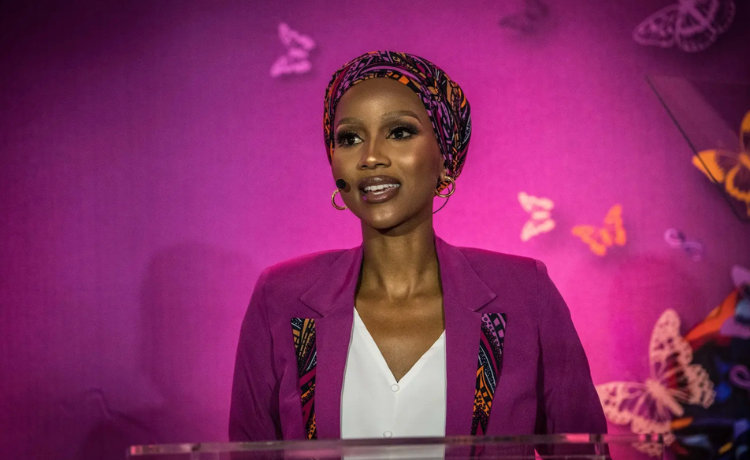
UNFPA has just closed its two-day virtual symposium on ending technology-facilitated gender-based violence, co-hosted by UNFPA, Global Affairs Canada and the Association for Progressive Communications. The symposium brought together advocates and technology experts to address these emerging harms.
Further efforts to lobby for justice will take place next week in New York, where UNFPA Global Champion Shudufhadzo Musida will carry the banner for women and girls, amid a number of events where UNFPA and its partners are convening discussions and calling for action.
Ms. Musida knows the devastating impact of digital harassment firsthand: “When violence is perpetrated in the virtual world, the fear, anxiety, loss of self-esteem, and sense of powerlessness are very real and enduring,” she says.


