
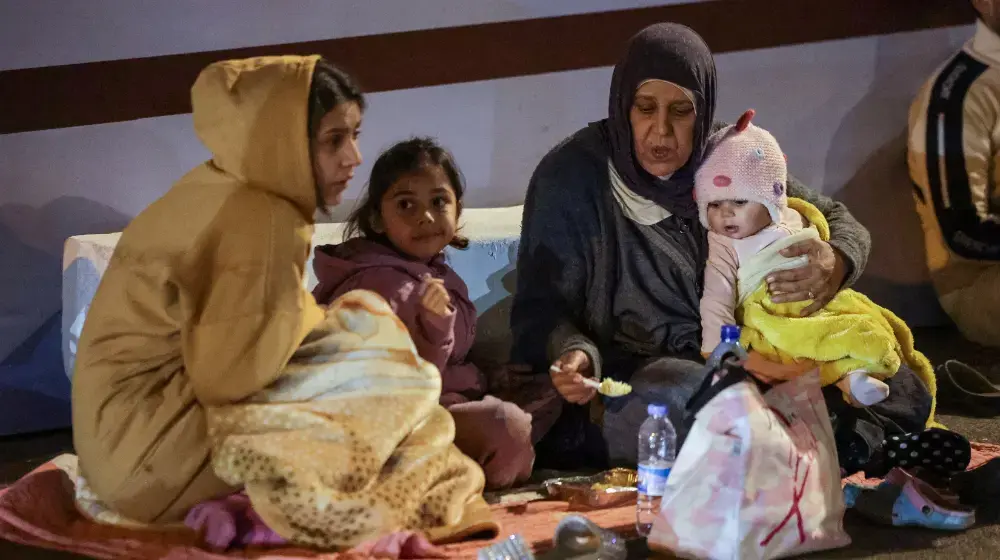
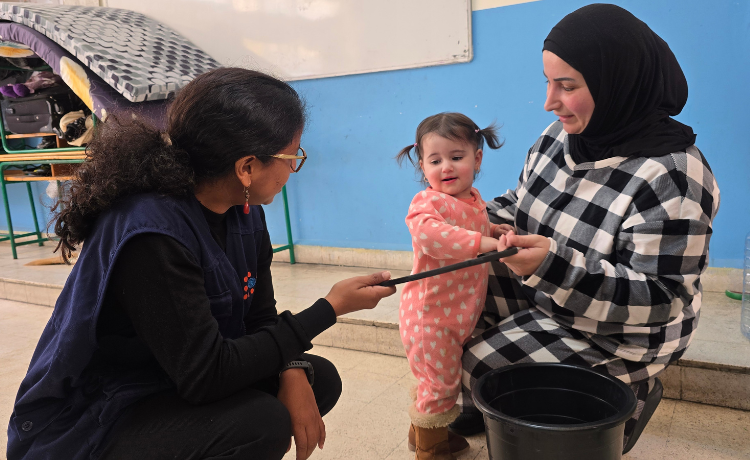
BEIRUT, Lebanon – “Mariam just turned two a few days ago, but this is already her second displacement,” explained her mother Nadia*, who was sheltering with her family at Sin El Fil school in Lebanon’s capital Beirut.
But the hallways no longer echo with the sound of children’s lessons. Instead, once again, they are filled with frightened silence and the hushed whispers of families who have lost everything. For Mariam, the concrete walls are a hauntingly familiar playground.
The family are among tens of thousands of people seeking refuge after Israeli airstrikes intensified across south Lebanon, the Bekaa Valley and the southern suburbs of Beirut in recent days.
“We are reliving this nightmare,” Nadia told UNFPA, the United Nations Population Fund, which is the UN’s sexual and reproductive health agency. Her family is back in the same displacement setting they had finally managed to leave just a year ago, after spending over two months there during the 2024 conflict, which at its peak left thousands dead and more than a million displaced.
The scale of the current crisis is escalating rapidly: Following a total evacuation order for the area south of the Litani River, the entirety of the southern suburbs of Beirut and dozens of villages in Bekaa, more than 1 million people – nearly a fifth of the population – face the imminent risk of being forced from their homes.
“Our home, our safety, our privacy, our livelihood – they have been taken from us twice now in less than two years,” said Nadia.
Health and protection risks soar in a crisis
Their journey was a gruelling 14-hour ordeal. Fleeing with nothing but the clothes on their backs, they joined thousands of cars stuck in gridlock. All the shelters along the way turned the family down as they were at full capacity, until they tried the school in Beirut.
“We slept in the car for two nights when we finally reached the school,” said Nadia, who described frigid frigid conditions with barely any supplies available. “The mattresses just arrived this morning.”
At least one woman was reported to have given birth on the street after becoming trapped in traffic while fleeing the bombardment.
She was assisted by a UNFPA mobile medical unit – which is staffed by a nurse, a gynaecologist and a social worker – deployed to reach displaced people in urgent need of healthcare and protection. A midwife has also been sent to attend to displaced pregnant women in a makeshift consultation room.
With roads choked by traffic and hospitals overstretched, access to sexual and reproductive health services in Lebanon is extremely disrupted, increasing the risks of unintended pregnancies and life-threatening complications for pregnant women. At least one woman was reported to have given birth on the street after becoming trapped in traffic while fleeing the bombardment.
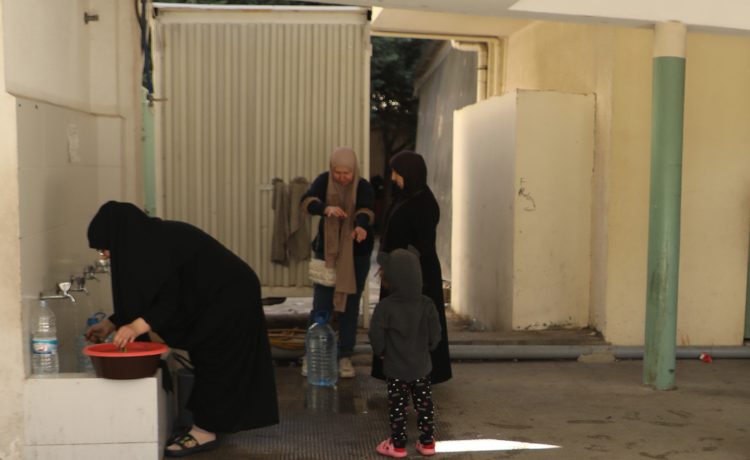
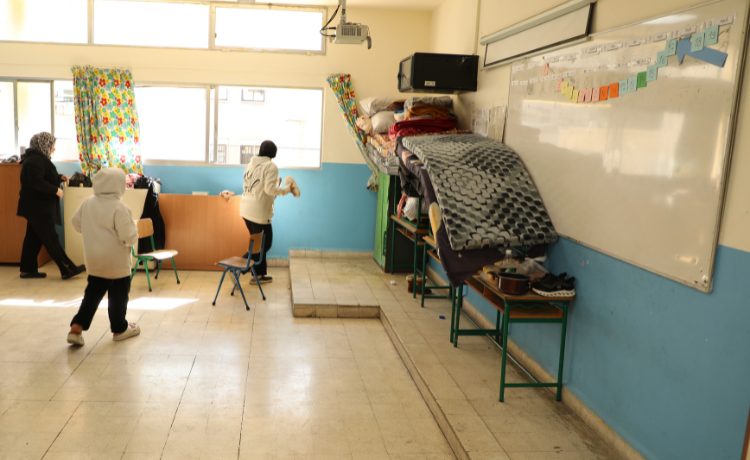
Even once people reach a place of refuge, there is no guarantee of safety or critical supplies. Most are overcrowded, unsanitary and lack any kind of separate facilities for women and girls. Families are packed into classrooms with little more than a curtain for separation, and inadequate lighting only adds to the high risk of gender-based violence for women and girls.
“The situation is catastrophic. One of the schools we’re supporting in the area is currently hosting more than 800 families,” said Cindy Hakme, a health programme manager with UNFPA’s local partner Caritas. “Men are sleeping in cars and women and children are sleeping in open spaces, in hallways and on cold tiles.”
UNFPA scales up response across Lebanon
As health and protection needs surge, UNFPA is working with the Government of Lebanon and local partners to rapidly scale up its operations providing sexual and reproductive health services and gender-based violence response.
So far, half of UNFPA-supported facilities in conflict-affected areas have been forced to close due to the violence and many health workers have been displaced, leaving the remaining services severely shortstaffed.
“The situation is catastrophic” – Cindy Hakme
Rima* went into labour at the Sin El Fil school during the 2024 conflict, and was referred by a UNFPA partner to give birth in a nearby hospital. She is now back sheltering at the same school with her daughter, Sama, who is just over a year and a half old. Although people tell her Sama must be ‘unlucky’, Rima takes a different view. “She is my angel, but I don't know how to protect her anymore.”
Despite these challenges, UNFPA has deployed seven mobile medical units across Lebanon to provide maternal healthcare and emergency obstetric support in collective shelters. Cash assistance is being distributed to survivors of gender-based violence who need shelter outside of collective areas, while information sessions on protection from sexual exploitation and abuse are being held.
UNFPA in also ensuring clinical management of rape, psychosocial support, and distributing dignity kits containing hygiene and menstrual supplies, as well as baby kits of essentials for pregnant women and new mothers.
*Names changed for privacy and protection


