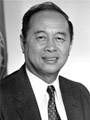
Former UNFPA Executive Director, UN Under-Secretary General
(7 August 1928–3 March 1987)
Rafael Montinola Salas was the first Executive Director of UNFPA, heading the agency from the time it became operational in 1969 until his death in March 1987. Under his leadership, UNFPA grew from a small trust fund into the world’s largest multilateral provider of population assistance.
Mr. Salas was a pioneer in the field of population. Indeed, he was one of its first true international advocates, conveying to others the importance of understanding the crucial links between population and development and the need to take population factors into account in development planning.
Born in Bago, Negros Occidental, in the Philippines, he graduated with high honours from the University of the Philippines in 1950, completing his B.A. (magna cum laude) and LL.B (cum laude) in 1953. He then attended Harvard University, where he obtained a master’s in public administration in 1955. Upon graduation, he returned to the University of the Philippines, where he held a variety of academic positions until 1966.
In 1966, Mr. Salas was called on to serve his country as Executive Secretary of the Republic of the Philippines under then-President Ferdinand E. Marcos. During his tenure as Executive Secretary, he was credited with solving the country’s annual rice production problem as action officer of the National Rice Sufficiency Programme.
From 1962 to 1969, Mr. Salas was a member of various Philippines delegations to international conferences, including the UN General Assembly. He headed the Philippines delegation to and served as Vice-President of the International Conference on Human Rights, held in Tehran in April and May of 1968. It is the conference that proclaimed: “Parents have a basic human right to determine freely and responsibly the number and the spacing of their children.”
Mr. Salas stepped down as his country’s Executive Secretary in 1969 when he began his post as UNFPA’s first Executive Director. Over the years, he received many honorary degrees and academic awards from around the world for his work and dedication in the field of population. His efforts to create global awareness and consensus about the importance of population to social and economic development earned him the title of “Mr. Population” by the international community. He also contributed a huge body of literature on government management and population issues to scholarly journals, magazines and newspapers.
To honour his legacy, UNFPA established the Rafael M. Salas Memorial Lecture series, providing a unique forum for distinguished guest lecturers to discuss important aspects of population and development.