Ending GBV and harmful practices

Joint evaluation of the Global Action Plan for healthy lives and well-being for all

Joint evaluation of the Global Action Plan for healthy lives and well-being for all

Document date: 2024

Evaluation type: Global

Region: n/a

Joint evaluation: Yes

System-wide evaluation: n/a

Download resources

The Global Action Plan for healthy lives and well-being for all (GAP) initiative, launched in 2018, seeks to enhance interagency collaboration and accelerate progress towards the health-related targets of the 2030 Agenda for Sustainable Development. UNFPA, along with 12 other agencies— Gavi, GFF, the Global Fund to fight AIDS, TB and Malaria, ILO, UNAIDS, UNDP, UNICEF, UNITAID, UN Women, WFP, WHO, and the World Bank—are signatories to this initiative. 

In 2024, WHO Evaluation Office led a joint evaluation of the GAP initiative. The UNFPA Independent Evaluation Office participated in the Evaluation Management Group, alongside evaluation offices from GEF, Global Fund, ILO, UNAIDS, UNDP, UNICEF, UNITAID, UN Women, WFP, and the World Bank. Covering 67 countries where the GAP approach was applied, the evaluation assesses the coherence, effectiveness, and sustainability of collaborative efforts from 2019 to 2024 at the country, regional, and global levels. The evaluation results are informing discussions among agency principals on the future of the GAP.

The evaluation concludes that, globally, the GAP aligns well with current and past international health initiatives, demonstrating continuity and opportunities to build on previous work. However, despite initial support from agency principals, achieving interagency coherence and country engagement has been challenging. While there is insufficient evidence to definitively conclude that the GAP has met, or will meet, its objectives of accelerating progress towards SDG 3 targets, it has not hindered progress. Importantly, the sustainability of the GAP and its outcomes must be considered within the broader context of global health and individual country contexts, where few are on track to achieve SDG 3 targets.

Based on the evaluation results, two potential paths forward were proposed. The first path suggests closing out the current GAP within six to twelve months, contingent upon the agencies reaching a consensus on whether closure serves their collective best interest. Alternatively, the second path recommends developing a new framework that retains select GAP elements. This evaluation equips signatory agencies with the necessary information—including evidence, benefits, trade-offs, and risks—to inform their decision-making regarding the future of the GAP. The management response accepts the first option and commits to preparing a 6-9 month sunsetting and close-out action plan with key milestones.
 

Evaluation documents

Evaluation Report
Executive Summary
Brief

Additional resources

Independent evaluation of the UNFPA Strategic Plan 2022-2025

Independent evaluation of the UNFPA Strategic Plan 2022-2025

Document date: 2024

Evaluation type: Global

Region: n/a

Joint evaluation: n/a

System-wide evaluation: n/a

Download resources

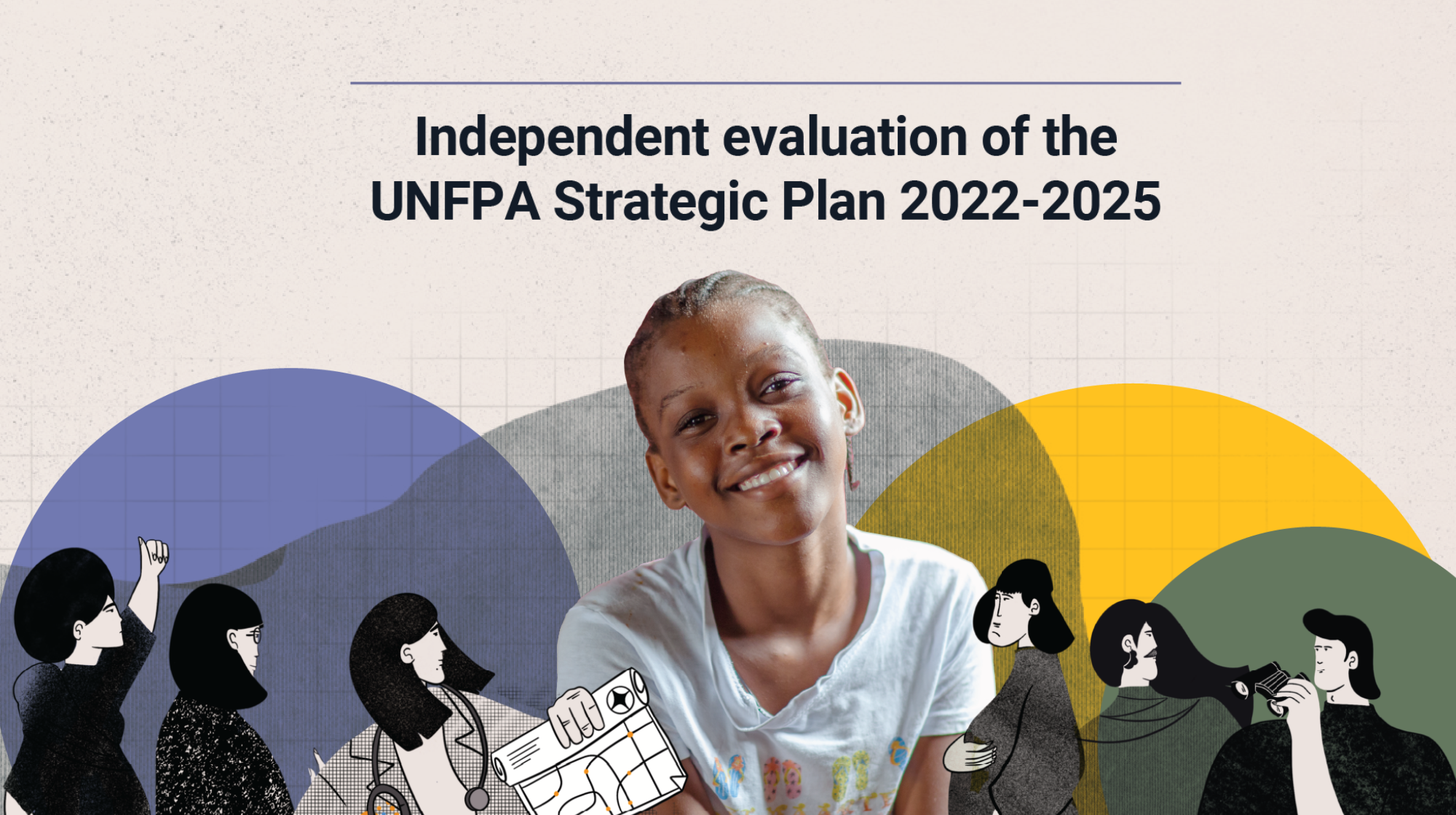
UNFPA has a bold vision: a world where every pregnancy is wanted, every childbirth is safe, and every young person's potential is fulfilled. The UNFPA Strategic Plan 2022-2025 is a crucial stepping stone towards this vision, focusing on three transformative results: ending preventable maternal deaths, ending unmet need for family planning, and ending gender-based violence and harmful practices. This plan is the second in a series of three strategic plans until 2030, each building on the last to accelerate progress towards the three transformative results.

This independent evaluation assesses the organizational readiness and strategic positioning of UNFPA to accelerate progress towards the achievement of the three transformative results, and provides evidence and insights for the development of the next UNFPA Strategic Plan 2026-2029. In particular, the evaluation examines two key innovations: six accelerators designed to drive faster results, and twelve strategic shifts that represent UNFPA's commitment to adapt and evolve its approach, to support the implementation of the strategic plan.

The evaluation concludes that while successive strategic plans aiming for the three transformative results provide continuity and focus, they require adaptability, with acceleration remaining relevant yet potentially insufficient for countries facing setbacks. The evaluation recommends to focus the next strategic plan on further acceleration - rather than unfinished business - and ensuring that efforts to protect the ICPD agenda are fully integrated into the approach.

While the three transformative results effectively focused UNFPA resources on key priorities, they do not fully encompass all stakeholder needs or the organization’s broader contributions to the ICPD Programme of Action and the Sustainable Development Goals. The next strategic plan should clarify the UNFPA strategic positioning in population dynamics and other key areas of work (such as HIV, gender equality, youth and adolescence and ageing) and the direct contribution of these areas to the SDGs and ICPD Programme of Action.

The shifts in the Strategic Plan 2022-2025 demanded substantial organizational effort, with clearer guidance, and needed to consider internal capacity constraints, especially in smaller country offices. The evaluation recommends operationalizing acceleration by clarifying and strengthening linkages between concepts and programming approaches well in advance of the launch of the new strategic plan.

A clearer approach to acceleration in the next strategic plan, and the country programmes, is needed in order to enhance coherence across UNFPA initiatives, align modes of engagement and guide human resource priorities at the country level. The evaluation recommends strengthening capacities to undertake the critical measures that will support acceleration, especially in normative work, funding to finance, knowledge management and strategic communications.

Finally, UNFPA has improved its humanitarian response capacity but needs clearer guidance and strategic integration to coordinate and implement resilience, humanitarian, development and peace efforts within resource constraints. The evaluation recommends better integration of humanitarian, development and peace-responsive interventions while taking into account the different and changing contexts within which UNFPA works.
 

Evaluation documents

Evaluation Report
Evaluation Brief
Evaluation Presentation
Management Response
Executive Board Paper
Statement by UNFPA Executive Director to the Executive Board
Statement by Director, UNFPA IEO to the Executive Board
Statement by UNFPA Deputy Executive Director-Programme on the Management Response

UNFPA Kazakhstan 5th Country Programme Evaluation (2021-2025)

Document date: 2024

Evaluation type: Country

Region: Eastern Europe & Central Asia

Country: Kazakhstan

Joint evaluation: n/a

System-wide evaluation: n/a

Download resources


The evaluation aims to demonstrate accountability for the performance of the fifth-country programme of UNFPA Kazakhstan. It also aims to support evidence-based decision-making to inform the development of the next country programme. The evaluation focused on UNFPA contribution to changing discriminatory social norms in Kazakhstan to accelerate the reduction in the unmet need for family planning and the reduction of gender-based violence.


Evaluation documents

Evaluation Report
Evaluation Quality Assessment

UNFPA Ethiopia 9th Country Programme Evaluation (2020-2025)

Document date: 2024

Evaluation type: Country

Region: East & Southern Africa

Country: Ethiopia

Joint evaluation: n/a

System-wide evaluation: n/a

Download resources

This evaluation provides an independent assessment of the 9th programme cycle of UNFPA Ethiopia. The evaluation assesses the geographic and demographic coverage of UNFPA humanitarian assistance and draws key conclusions from past and current cooperation to provide a set of clear, forward-looking and actionable recommendations for the next programme cycle.

Evaluation documents

Evaluation Report
Evaluation Brief
Evaluation Presentation
Evaluation Quality Assessment
Management Response

News

Health and humanitarian workers face record violence: Here are 5 reasons the world must take action

calendar_today18 August 2024

The Al-Shifa Hospital in northern Gaza was completely destroyed following a bombing raid by Israeli forces. © UNFPA/Dominic Allen
1

5ème Programme Pays de l'UNFPA en République Démocratique du Congo (2020-2024)

Document date: 2024

Evaluation type: Country

Region: West & Central Africa

Country: Democratic Republic of the Congo

Joint evaluation: n/a

System-wide evaluation: n/a

Download resources

Les objectifs généraux assignés à cette évaluation consistaient d’une part, à fournir une appréciation indépendante du 5ème CPD au Bureau de Pays de l’UNFPA, au Gouvernement de la RDC, aux partenaires de mise en oeuvre du Bureau de Pays au niveau national et provincial, aux détenteurs de droits impliqués dans les interventions et les organisations qui les représentent, à l’UNCT, au Bureau régional UNFPA ESARO, aux bailleurs de fonds., au Siège de l’UNFPA, ainsi qu'au public en général ; et d’autre part, à élargir la base de données factuelles pour la conception du prochain cycle de programme. De manière spécifique, cette évaluation devait permettre : (i) d’apprécier de façon indépendante la conception, la pertinence, l’efficacité, l’efficience, la durabilité et la coordination des appuis de l’UNFPA ; (ii) d’apprécier le rôle joué par le bureau UNFPA RDC concernant les mécanismes de coordination de l’UNCT en vue d’améliorer la contribution collective des Nations-Unies aux résultats du développement ; et (iii) de tirer des conclusions sur la coopération passée et actuelle, et fournir un ensemble de recommandations claires, stratégiques et concrètes pour le prochain cycle de programme.

Evaluation documents

Evaluation Report
Evaluation Quality Assessment
Management Response

Additional resources

Job description

The Programme Specialist is responsible for providing integrated programming and technical assistance to integrating gender transformative approaches, and addressing discriminatory gender and social norms. This Specialist will report directly to the Programme Adviser, (Gen/Tech/Prog), P5, 142366. 

About UNFPA

We promote gender equality and empower women, girls and young people to take control of their bodies and their futures.

Learn more

UNFPA Angola 8th Country Programme Evaluation (2020-2022)

Document date: 2022

Evaluation type: Country

Region: East & Southern Africa

Country: Angola

Joint evaluation: n/a

System-wide evaluation: n/a

Download resources

This evaluation independently assesses the UNFPA Angola 8th country programme, offering evidence-based insights to inform the design of the next programme cycle. The evaluation also assesses the geographic and demographic coverage of the UNFPA humanitarian assistance, and the organization's ability to integrate immediate, life-saving support with long-term development goals.

Evaluation documents

Evaluation Report
Management Response
Evaluation Quality Assessment

Are we getting there? A synthesis of UN system evaluations of SDG 5

Are we getting there? A synthesis of UN system evaluations of SDG 5

Document date: 2024

Evaluation type: Global

Region: n/a

Joint evaluation: Yes

System-wide evaluation: n/a

Download resources

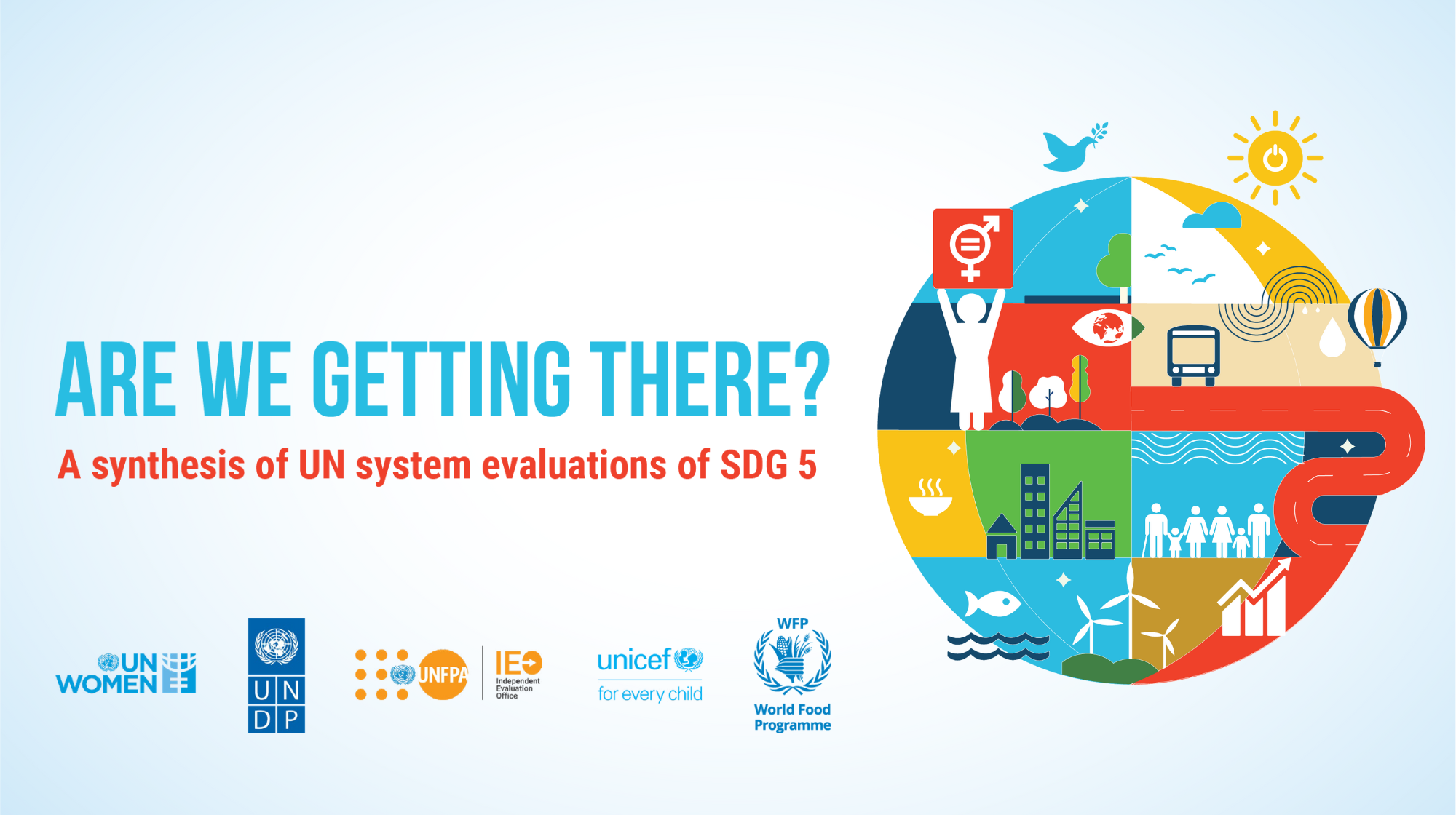
At the midpoint of the 2030 Agenda for Sustainable Development, progress on SDG 5 on achieving gender equality and empowering all women and girls has stalled. Recognizing this challenge, the independent evaluation offices of UN Women, UNDP, UNFPA, UNICEF and WFP collaborated to conduct an inter-agency synthesis of United Nations system evaluations related to SDG 5.

The dataset of SDG 5 evaluations included 619 evaluation reports from 33 United Nations entities. Of these, nearly half of the evaluations were chosen for further analysis. The analysis synthesised evidence on what helps and hinders progress, what approaches work and do not work, and key lessons and evidence gaps across the nine targets of SDG 5.

The report identifies several factors that contribute to progress towards SDG 5. These include the critical role of the United Nations towards advancing gender-responsive legislation, and the effectiveness of integrated and holistic programming. The report further highlights the use of knowledge, data and research to support advocacy efforts, technical support and capacity strengthening, and the essential role of civil society partners in driving progress towards SDG 5. 

However, operationalizing the principle of ‘leaving no one behind’ remains a challenge. Prioritising gender in humanitarian situations must be more sustained and comprehensive. Stronger and innovative monitoring and evaluation approaches are needed to assess contribution more rigorously towards gender equality outcomes. Harmful social norms and inadequate financing for gender equality initiatives remain significant barriers. Government commitment and institutional readiness are critical enabling factors for the development and implementation of legislation, policies and services. Evaluations also highlight the detrimental impact of COVID-19 on gender equality outcomes and programming across the targets. 

These findings can catalyse action by providing policymakers, programme implementers, donors and United Nations agencies with evidence and lessons learned to speed up collective efforts to accelerate progress on SDG 5. 

Getting there together: A synthesis of inter-agency programme evaluations on SDG 5: A companion to ‘Are we getting there? A synthesis of UN system evaluations of SDG 5’

With a growing emphasis on United Nations inter-agency collaboration, this companion report analyses 68 inter-agency evaluations, including those that were excluded from the main synthesis report due to their 2023 completion date. This analysis provides unique insights into joint United Nations programming for SDG 5, examining its strategic significance, effectiveness, coherence, enabling factors, barriers, recommendations, evidence gaps, and lessons learned. Specifically, this report explores the role of inter-agency work in achieving SDG 5 targets, successful collaborative practices, areas for improved coordination, and existing knowledge gaps.


Evaluation documents

Synthesis of UN system evaluations of SDG 5
Synthesis of inter-agency programme evaluations of SDG 5

Additional resources

Job description

Note: This post will commence on 1 August 2024.

The Position:
The Adviser post is located in the Gender and Human Rights Branch of the Programme Division and reports directly to the Branch Chief who provides overall strategic direction. S/He is the principal policy adviser and authoritative expert for the area of Gender Equality and Human Rights and its linkages with the ICPD Programme of Action, the 2030 Agenda for Sustainable Development, and the UN Reform agenda. This position is based in New York and works closely with the Coordinator of the Programme Liaison Bureau with a special focus on New York related partnerships, intergovernmental processes, interagency collaborations and related donor and advocacy tasks.

About UNFPA

We promote gender equality and empower women, girls and young people to take control of their bodies and their futures.

Learn more

We use cookies and other identifiers to help improve your online experience. By using our website you agree to this, see our cookie policy

X