Video

I said no to FGM: Latty

calendar_today06 February 2018

I said no to FGM: Latty

I said no to FGM: Latty

Latty, a 14-year-old girl from Burkina Faso, calls on the international community to work together to end female genital mutilation (FGM). Learn more here

Publication date

Feb 2018

Author

UNFPA

Resources

Bending the curve: FGM trends we aim to change

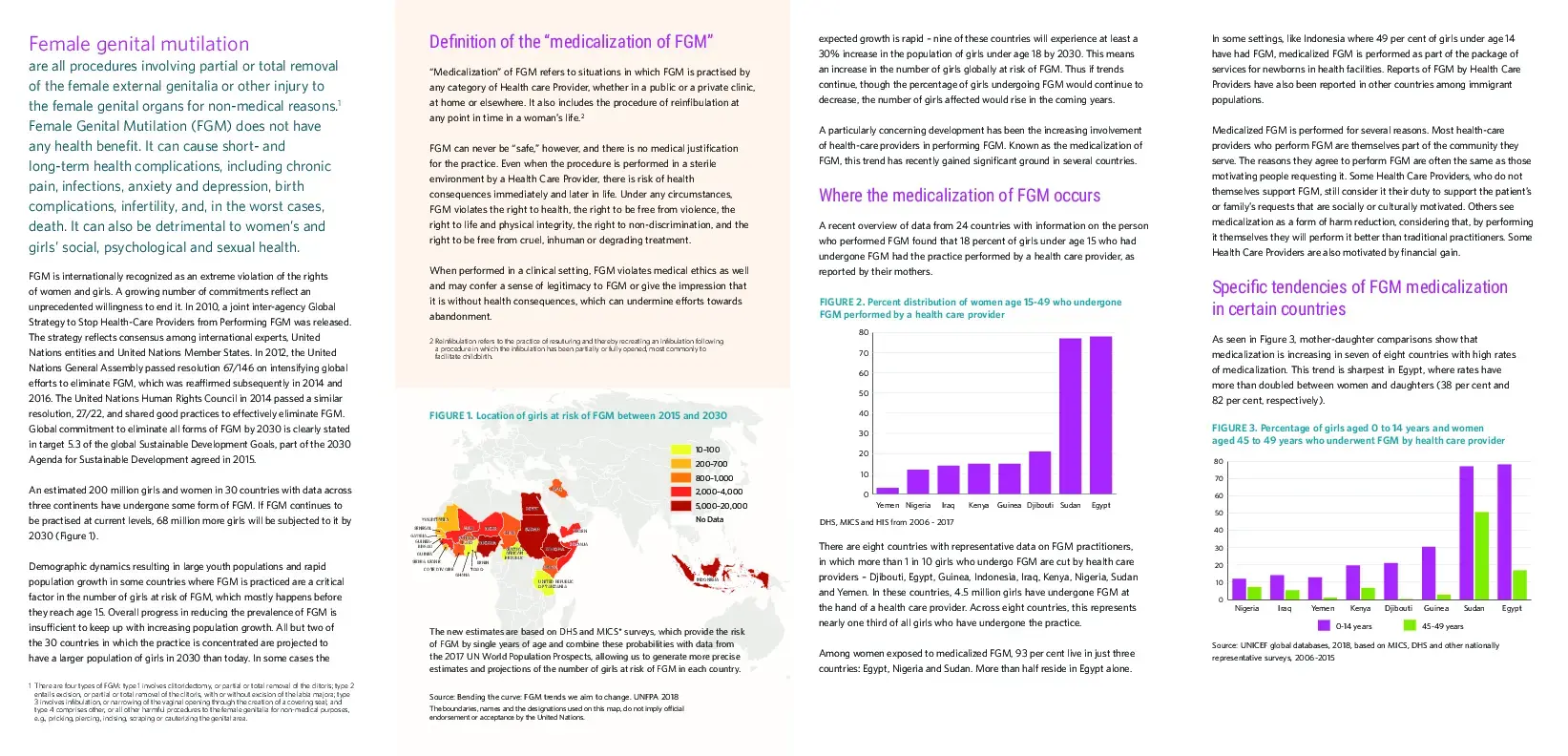
If FGM continues to be practised at current levels, 68 million girls will be subjected to FGM by 2030.

New data shows the numbers are larger, and increasing.

Prior estimates did not include data from Indonesia, thereby underestimating the number of girls having FGM each year in high-risk countries. Prior estimates indicated approximately 3.2 million girls have FGM per year.

Why will the number increase? Because of population growth among young girls in 25 countries where FGM is prevalent and relevant data are available.

Slideshow

I am powerful: Girls around the world stand up against FGM

calendar_today06 February 2018

1/8

Female genital mutilation (FGM) is practiced around the world, despite the risk of haemorrhage, infection and even death. But girls are rising up against this practice. In Egypt, 14-year-old Haneen is an advocate for ending FGM. Luca Zordan for UNFPA

In many places, FGM and child marriage are linked. In Ethiopia, Sofia Hussen experienced both. Now 18, she uses her own story to call for change. “I am a living example,” she said. Luca Zordan for UNFPA

Sharleen Cherop, 17, in Kenya, fled both FGM and child marriage. “I refused,” she said, recalling how she ran away from home to escape. She found refuge at a school, and is now an advocate for children’s rights. Luca Zordan for UNFPA

Anissa, 15, is a Syrian refugee in Egypt. FGM is not traditionally practiced in Syria, but some refugees have adopted the practice in Egypt, where it is widespread. Anissa works with the youth group Y-Peer to help end FGM. Luca Zordan for UNFPA

In Burkina Faso, Latifatou Compaoré, 14, was inspired by her mother to call for the elimination of FGM. She recorded a song about the subject, which has been played on national television and radio. Luca Zordan for UNFPA

In Ethiopia, Fatuma Abdu participates in a UNFPA-supported adolescent girls’ group that discusses the subject. “I teach my family and other community member the cause and effects of FGM.” Luca Zordan for UNFPA

Tabitha Marwa, 15, in Kenya, avoided FGM with support from her parents, but the backlash from her community was severe. For her safety, she was sent to a rescue centre. Today, she is a role model for other girls. Luca Zordan for UNFPA

Fatmah, in Egypt, learned about the consequences of FGM from her mother. Today, at 13, Fatmah encourages people to reject the practice. “FGM is wrong and it has lots of harms,” she said. “I convinced my sister not to cut her kids.” Luca Zordan for UNFPA

News

“I refused”: Brave women and girls take a stand against FGM

calendar_today06 February 2018

Latty, 14, was inspired by her mother to call for the elimination of FGM. Luca Zordan for UNFPA
1

News

A vision of change: Pioneer spends 30 years advocating end to FGM in Sudan

calendar_today31 January 2018

Abdullah Ali Abdullah has spent 30 years working with communities in North Kordofan to encourage abandonment of female genital mutilation. © UNFPA Sudan
1

United Kingdom of Great Britain and Northern Ireland

Donor rankings include UN-to-UN transfers, which are UNFPA's top source of revenue overall.

1

Effective 1 January 2022, UNFPA adopted a new revenue recognition policy; however, for the purposes of this website, information is presented based on previous policy to allow comparability of information across different years.

2024 | Top
Donor Global Statistics

News & Updates

Updates
UNITED NATIONS, New York – The Swedish International Development Cooperation Agency (Sida) has pledged an additional contribution of SEK75.0 million – approximately US$ 6.9 million – to the UNFPA-UNICEF Joint Programme…
03 January 2024 Read Story
News story
Taiz, YEMEN – “One day, when I was returning from fetching water, I collapsed on the road. I was bleeding so badly that I knew I was going to lose my baby.”  Umm Mahra was 31 years old and five months pregnant when…
06 December 2023 Read Story
Updates
Adjumani, UGANDA – Born with an intellectual disability, 17-year-old Miriam should have been supported by her family and community to overcome the challenges life had presented her with. Instead, she was ostracized,…
04 December 2023 Read Story
Joint Evaluation of the UNFPA-UNICEF Joint Programme on the Abandonment of Female Genital Mutilation: Accelerating Change Phase I and II (2008–2017)

Resource date

01 July 2019

Administrative Resource

Joint Evaluation of the UNFPA-UNICEF Joint Programme on the Abandonment of Female Genital Mutilation: Accelerating Change Phase I and II (2008–2017)

1

News

UNFPA scales up response after Iraq earthquake

calendar_today24 November 2017

UNFPA is distributing essential hygiene supplies to women and girls displaced by the earthquake. Photo courtesy of Civil Development International
1
Cover image By the Numbers

Publication date

2017

Author

UNFPA-UNICEF Joint Programme on Female Genital Mutilation/Cutting Publication Date: 2017

Number of pages

78

Annual Report

2016 Annual Report of FGM Joint Programme: By the Numbers

1

News

From child bride to beauty expert: one Jordanian woman’s story

calendar_today19 October 2017

Child marriage rates are rising in Jordan, according to a recent report. © UNFPA Jordan/ Elspeth Dehnert
1

We use cookies and other identifiers to help improve your online experience. By using our website you agree to this, see our cookie policy

X