1
Updates
UK announces £4.25 million (c. $5.3 million) for UNFPA’s humanitarian response in the occupied Palestinian territories to support women and girls
25 February 2024
Five ways to change life for women in the Democratic Republic of the Congo
Midwife Esther Okunia supports displaced women and girls in the province of Ituri.
All photos © UNFPA DRC/Junior Mayindu

15 February 2024
News story
UNFPA urges leaders to address gendered, discriminatory impacts of climate change at COP28
29 November 2023
1
News
After surviving sexual violence, youth leader creates change for girls with disabilities in the Democratic Republic of the Congo
13 February 2024
1
UNFPA-UNICEF Joint Programme on the Elimination of Female Genital Mutilation
A movement to end this harmful practice by 2030
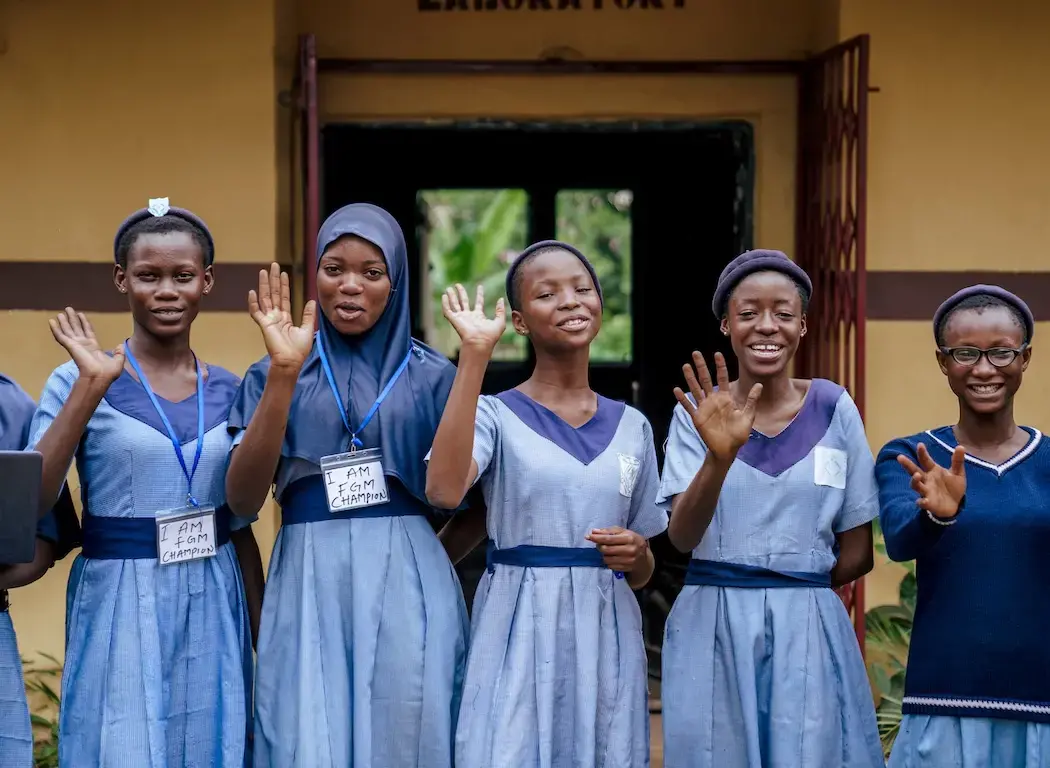
What is the Joint Programme on the Elimination of Female Genital Mutilation?
UNFPA, in partnership with UNICEF, leads the largest global programme to accelerate the elimination of female genital mutilation. The Programme is implemented in 18 focus countries in Africa and Asia: Burkina Faso, Djibouti, Egypt, Eritrea, Ethiopia, The Gambia, Guinea, Guinea-Bissau, Indonesia, Kenya, Mali, Mauritania, Nigeria, Senegal, Sudan, Somalia, Uganda and Yemen, with a reach and influence in other countries and regions where this harmful practice is prevalent.
The Joint Programme was established in 2008, with both agencies working in close collaboration with governments and partners across all levels – grassroots, community, subnational, national, regional and global. It covers multiple sectors – among them social, education, health, religion, economics and politics – advocating for the scale-up of evidence-based interventions and results. Currently the programme focuses on five strategies: promoting girls’ agency; building movements with a special focus on youth; engaging women-led organizations; funding diversification; and expanding and intensifying global influence.
Why get involved?
Female genital mutilation is a violation of human rights and is never safe, with immediate health risks that can span a lifetime, including chronic pain, infections, increased risk of childbirth complications and psychological trauma.
Ending this harmful practice is an achievable Sustainable Development Goal to safeguard and protect the 68 million girls and women at risk. Your involvement can take many forms – from advocacy and policy making to providing financial support or implementing interventions on the ground. By participating in this global movement, you can contribute to ending female genital mutilation and creating a world where every girl and woman lives free from violence and discrimination.
Updated 4 February 2026
Top 10 achievements since 2008
-
 girls aged 0 to 14 years were protected from undergoing female genital mutilation
-
 women and girls have initiated conversations on eliminating female genital mutilation
-
 people made public declarations to abandon female genital mutilation
-
 communities established surveillance systems to protect girls from undergoing female genital mutilation
-
 individuals were reached by mass media messaging on female genital mutilation
-
 grassroots organizations have been integrated into coalitions and networks working on the elimination of female genital mutilation
-
 community and front-line workers from 241 implementing partners were engaged in interventions that aim to end female genital mutilation
-
 girls and women received female genital mutilation–related prevention and protection services
-
 health-service delivery points have at least one health worker trained to provide repair or prevent female gential mutilation
-
 arrests were made as part of enforcing female genital mutilation legislation
{"2024":"18","2023":"18"}
Where we work
Explore snapshots of the focus countries. Each snapshot offers a brief synopsis of the context, including drivers, prevalence, attitudes and progress in eliminating female genital mutilation, and a list of key programme partners. The snapshots also highlight key programmatic achievements and an activity showcasing how the current Phase IV of the programme operates at the field level.


Partnerships and funding
Partnerships are at the heart of the UNFPA-UNICEF Joint Programme’s strategy to eliminate female genital mutilation. The Joint Programme partners include a diverse set of multi-sectoral stakeholders representing governmental institutions, national and international organizations, civil society organizations, grassroots organizations, women’s groups, youth-led initiatives, academia and front-line workers, all striving together to end female genital mutilation. These partnerships are at global, regional, national and subnational levels, working to create an enabling environment for change. This ranges from policy-making to community-level and grassroots interventions, building a world where girls and women are safe, empowered and free to live their lives without the threat of female genital mutilation.
The Joint Programme’s funding partners provide the financial support to catalyze and scale up evidence-based effective interventions that result in norm changes to end female genital mutilation. In the current fourth phase, the Joint Programme is generously funded by the Governments of Belgium, Canada, France, Germany, Iceland, Italy, Luxembourg, Norway, Spain, Sweden, the United Kingdom, the United States and the European Union, as well as the Nordisk Foundation. Nonetheless, additional financial resources are required to further scale up interventions to be able to achieve the global target of eliminating female genital mutilation by 2030.
Every year $1.4 billion is spent treating female genital mutilation health-related complications. Meanwhile for an estimated cost of $2.4 billion, the practice could instead be eliminated in 31 priority countries.
Funds received by the Joint Programme in 2024
News
Raising the voices of survivors to create a generation free from female genital mutilation in Ethiopia
08 February 2024
1
"I wanted to be the last woman on earth to have undergone FGM."
Survivors in Kenya say the practice must stop with their daughters
All photos and video © Christina Nwabugo
05 February 2024
News
Breaking the cycle for survivors: UNFPA offers counselling and support to abandon female genital mutilation in Yemen
05 February 2024
1
News
One year on, Joint Innovation Challenge winners keep up the fight against gender-based violence
25 January 2024
1
Events
International Day of Zero Tolerance for Female Genital Mutilation 2024
06 February 2024
Global

1