

What is the UNFPA Supplies Partnership?
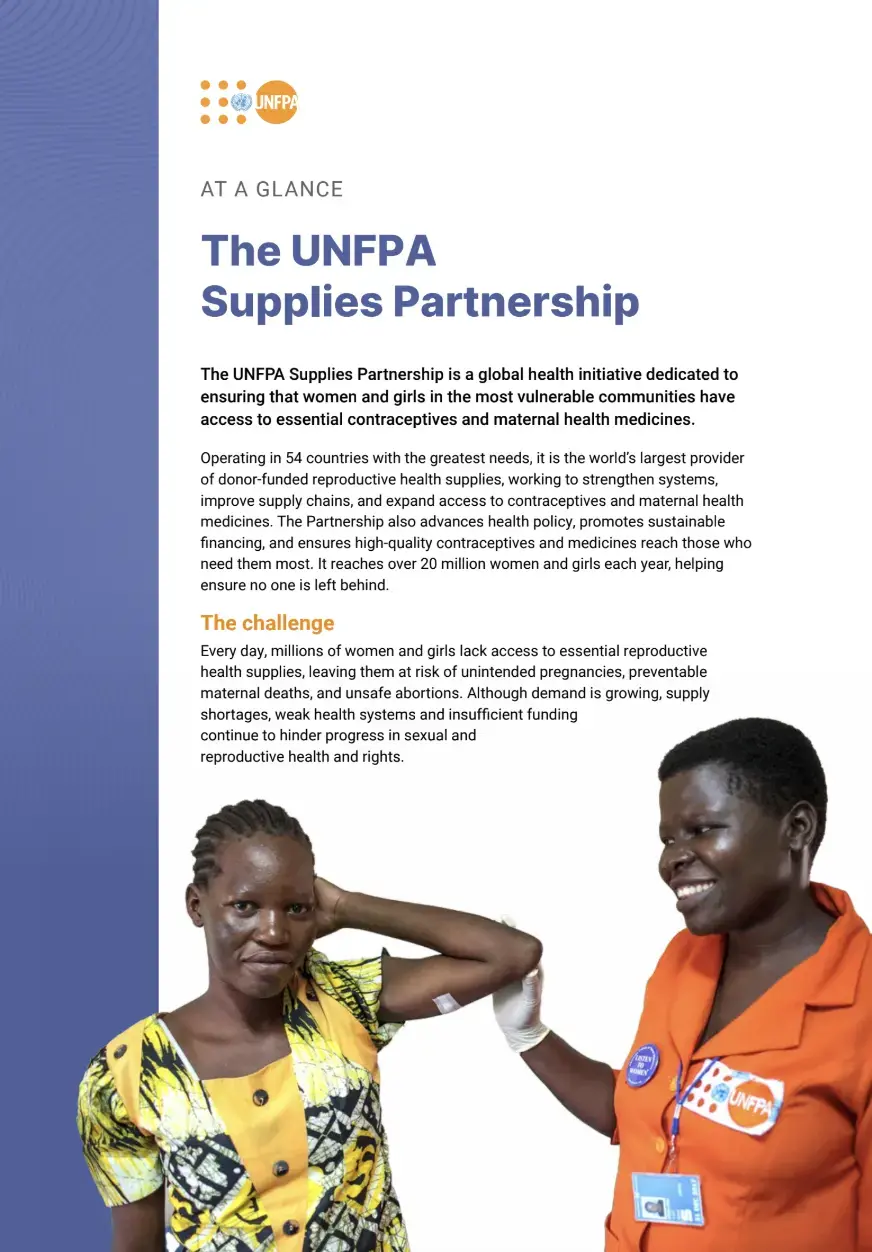
The UNFPA Supplies Partnership is a global health initiative focused on sexual and reproductive health and rights. It supports 54 of the world’s lowest-income countries to strengthen their health systems by improving supply chains, advancing policy, diversifying financing, and expanding access to quality-assured contraceptives and maternal health medicines.
Drawing on UNFPA’s 50 years of family planning expertise, the Partnership serves as the primary global provider of public sector reproductive health commodities, directing an annual budget of some $185 million towards advancing sexual and reproductive health and rights in communities where access matters most.
Where does the Partnership operate?
The Partnership operates in countries across Africa, Asia, Eastern Europe, Latin America and the Caribbean, and the Pacific, working with nations with the greatest need for contraceptive access, maternal health support and strengthened reproductive health systems. Nearly two thirds of programme countries face humanitarian crises or fragile contexts, making this partnership even more vital.
Partner countries include: Afghanistan, Angola, Benin, Bolivia, Burkina Faso, Burundi, Cambodia, Cameroon, Central African Republic, Chad, Comoros, Congo, Côte d'Ivoire, Democratic Republic of the Congo, Djibouti, Eritrea, Ethiopia, The Gambia, Ghana, Guinea, Guinea-Bissau, Haiti, Honduras, Kenya, Kyrgyz Republic, Lao People's Democratic Republic, Lesotho, Liberia, Madagascar, Malawi, Mali, Mauritania, Mozambique, Myanmar, Nepal, Niger, Nigeria, Pakistan, Papua New Guinea, Rwanda, Sao Tome and Principe, Senegal, Sierra Leone, Somalia, South Sudan, Sudan, Tajikistan, United Republic of Tanzania, Timor-Leste, Togo, Uganda, Yemen, Zambia, Zimbabwe and Pacific Island Countries and Territories*.
*The Cook Islands, the Federated States of Micronesia, Fiji, Kiribati, the Marshall Islands, Nauru, Niue, Palau, Samoa, Solomon Islands, Tokelau, Tonga, Tuvalu and Vanuatu
Who does the Partnership serve?
The Partnership helps to build stronger national systems, supports sustainable financing and expands equitable access to care even in humanitarian settings.
Specifically, the Partnership collaborates with governments to serve:
- More than 20 million women annually through strengthened public health systems;
- Remote, rural and underserved communities through last-mile supply chain improvements;
- Crisis-affected populations via emergency reproductive health kits and mobile services;
- Persons with disabilities through inclusive, accessible reproductive health services;
- Youth and adolescents with stigma-free contraceptive options and information.
The Partnership supports health systems by:
- Building government capacity for sustainable domestic financing and for procuring quality-assured products at negotiated prices;
- Strengthening supply chains to keep shelves stocked and ensure reliable access;
- Integrating services across family planning, maternal health and HIV programmes;
- Strengthening the capacity of health workers to deliver quality, rights-based family planning services.
How does the Partnership contribute to global goals and UNFPA’s Transformative Results?
The Partnership is a key driver of global commitments on sexual and reproductive health, accelerating progress towards the Sustainable Development Goals, the International Conference on Population and Development (ICPD) Programme of Action and UNFPA's Transformative Results.
Sustainable Development Goals:
- SDG Target 3.7: Universal access to sexual and reproductive healthcare services, including family planning and education.
- SDG Target 3.8: Universal health coverage, financial risk protection and access to essential medicines.
- SDG Target 5.6: Universal access to sexual and reproductive health and reproductive rights.
ICPD Programme of Action:
The Partnership exemplifies the ICPD vision that reproductive health is central to sustainable development. By ensuring access to quality reproductive health supplies and strengthening country-owned health systems, the Partnership advances the fundamental principle that reproductive rights are human rights.
UNFPA’s Transformative Results:
- Ending the unmet need for family planning through expanded contraceptive access and choice;
Ending preventable maternal deaths via life-saving maternal health medicines and strengthened health systems;
Ending gender-based violence and harmful practices by empowering women with reproductive autonomy.
How is the Partnership governed?
The Partnership operates through a participatory governance structure that ensures accountability and transparency to all stakeholders. The Steering Committee comprises donors, programme governments, civil society organizations and strategic partners, and provides oversight and strategic direction for the Partnership.
Members are organized into constituencies, with rotating leadership every three years to ensure inclusive representation and fresh perspectives. Three specialized subcommittees review priorities and resources: Strategy and Planning, Finance and Risk, and Leadership.
This governance model ensures that those most affected by the Partnership’s work have a direct voice in strategic decisions. At the same time, it maintains donor oversight and technical expertise from implementing partners.