
Myanmar
Myanmar faces a protracted humanitarian crisis marked by ongoing conflict, mass displacement, and severe disruptions to essential services – conditions that disproportionately affect women and girls.
Access constraints, damaged roads and intermittent power supplies routinely cut communities off from health facilities, while overcrowded shelters without privacy heighten risks of gender-based violence. In many townships, weakened healthcare and disrupted supply chains leave routine maternal care, contraceptive supplies and survivor support services increasingly out of reach.
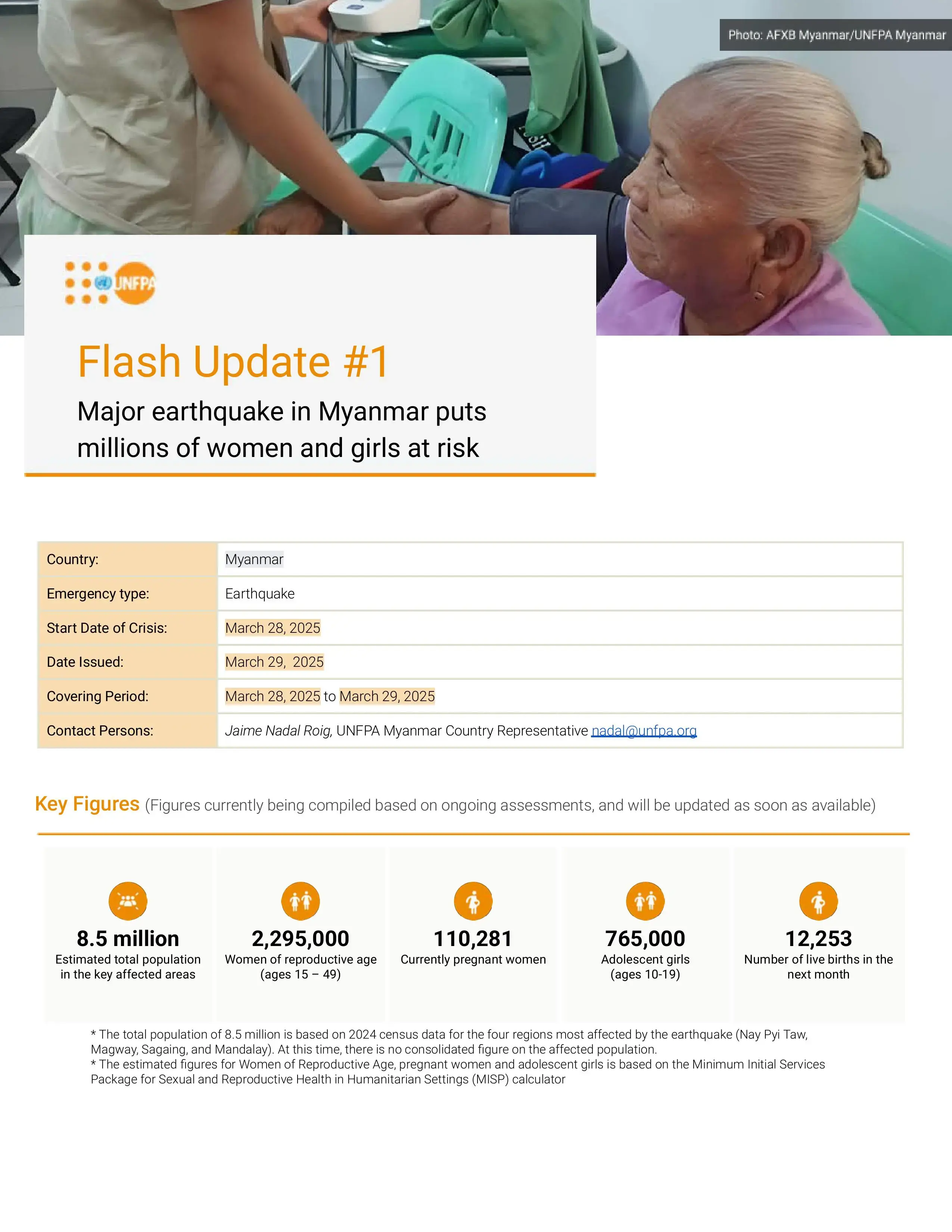
The crisis deepened further on 28 March 2025, when a 7.7-magnitude earthquake struck parts of central Myanmar that were already grappling with an extreme humanitarian crisis. In the 58 hardest-hit townships, an estimated 17 million people were affected, among whom were some 4.6 million women of reproductive age and more than 220,000 pregnant women. They faced acute risks as clinics, roads, water systems and sanitation infrastructure were damaged or destroyed. Overcrowding in temporary shelters, high temperatures coupled with monsoon flooding, and repeated aftershocks compounded the situation faced by women and girls and disrupted essential services.
As Myanmar enters 2026, the needs remain immense. Around 5.9 million women and girls of reproductive age require humanitarian assistance, including some 455,000 pregnant women and girls. At the same time, around 7.6 million people will need gender-based violence response services, reflecting the scale of protection risks in both conflict-affected and displacement settings.
Read more text
UNFPA aims to support over 690,000 people in 2026, prioritizing the most at-risk women, girls and adolescents. In a highly constrained operating environment, UNFPA emphasizes mobility, integration and continuity of care. Mobile teams deliver integrated sexual and reproductive health services, gender-based violence protection, and mental health and psychosocial support, restoring access where facilities are damaged or movement is restricted. Essential sexual and reproductive health commodities are reaching affected areas, while safe spaces for women and girls provide case management, counselling and referrals. Together, these approaches help sustain quality, confidential and survivor-centred care even when formal systems are disrupted.
The outlook remains precarious. Persistent insecurity, damaged infrastructure, fuel shortages, power cuts and market volatility continue to delay outreach and weaken referral pathways. Sustained access, resources and safe referral pathways will be critical to ensuring women and girls can access timely, trusted care.
Updated 5 January 2026